




Integrated LED batten or LED tube batten?
The first key decision is the batten's light source: either the LEDs are built in, or the batten holds a replaceable LED tube (usually T8 format). Each option has its advantages.
| Batten type | Description | Advantages | Drawbacks | Ideal for |
|---|---|---|---|---|
| Integrated LED battens | Fixed LED modules built into the housing (no replaceable tube). |
| The whole fitting must be replaced if it fails. | New installations looking for performance and a clean design. |
| LED battens for T8 LED tubes | Empty housing that takes a replaceable T8 LED tube. See compatible battens. |
| Less slim-looking than an integrated batten. | Simpler maintenance (intensive professional use) or low-cost renovation. |


LED batten mounting options
Most battens are surface-mounted, on a wall or ceiling for example, using clips or screws. This direct mounting suits most situations (garage, corridor, workshop, commercial and industrial spaces), as the slim profile of LED fittings keeps them discreet once installed. Other models are designed for different mounting types to meet specific needs.
| Batten type | Description | Advantages | Ideal for | Examples |
|---|---|---|---|---|
| Surface-mounted / wall LED battens | Fixed directly to the wall or ceiling with clips/screws. |
| Garages, cellars, workshops, corridors, car parks, commercial and industrial spaces. |  |
| Recessed LED battens | Built into a ceiling, wall or furniture; only the diffuser remains visible. |
| Suspended ceilings, offices, coving, shelving, bespoke integrations. |  |
| Suspended LED battens | Hung from the ceiling on cables or chains (kits included). |
| Kitchens (islands), dining rooms, laboratories, shops, industrial-style workshops. |  |
| Linkable LED battens | Connected to one another (wired electrically in parallel) via through-wiring or connectors. |
| Long corridors, shelving, aisles, garages/workshops, large worktops. |  |
Additional options and features
An LED batten can come with handy options that improve ease of use or safety. Here are some of the features available and what they are for:
| Batten type | Description | Advantages | Ideal for |
|---|---|---|---|
| LED battens with motion sensor | Built-in IR or microwave sensor that switches the light on and off automatically. |
| Areas people pass through: garages, corridors, cellars, car parks. |
| LED battens with emergency lighting | Built-in battery providing minimum lighting during a power cut (1 to 3 h). |
| Professional premises, communal areas, car parks, buildings open to the public. |
| Rechargeable LED battens | Run on a rechargeable internal battery (USB), with no permanent connection. |
| Cupboards, under cabinets, garages without power, campervans, temporary worksites. |
How to choose an LED batten: key criteria
Before choosing an LED batten, assess the area to be lit and the mounting height to work out the right length and light output.
LED batten length
According to a professional guide, here is a rough idea of the area lit depending on batten length:
| Batten length | Recommended area | Typical uses |
|---|---|---|
| 30 cm LED batten | < 2 m² | Inside furniture, alcoves, cupboards. |
| 60 cm LED batten | 2 to 6 m² | Worktop, kitchen, bathroom, small workshop. |
| 90 cm LED batten | 6 to 10 m² | Corridor, single office, home garage. |
| 120 cm LED batten | 10 to 20 m² | Garage, store, shop, large offices. |
| 150 cm LED batten | > 20 m² | Warehouses, car parks, industrial spaces. |
Tip
Don't hesitate to add more light points if needed to avoid dark spots.
Power and luminous flux
Don't rely on electrical watts alone: look above all at the luminous flux stated in lumens, which tells you how much light is emitted. Choose a flux suited to the size and use of the room: a workshop or industrial space, for example, needs more lumens than a kitchen or cellar. As a rule, the longer the LED batten, the higher its light intensity, since it holds more LEDs along its length.
- Luminous efficacy (lm/W): this is the ratio of lumens per watt. The higher it is, the more energy-efficient the LED batten (it gives more light for the same power consumption). Current models typically offer around 100 lm/W at entry level, and up to 150 lm/W (or more) for the highest-performing battens.
For example: around 4,800 lumens can be achieved with ~30 W at an efficacy of 160 lm/W, compared with ~40 W at 120 lm/W.
Choosing a high-efficacy LED batten means you get as much light (or more) while using less energy, which reduces both the number of fittings needed and your electricity bill.
Finally, make sure the total luminous flux of the batten you choose matches your needs.
As a guide, a 120 cm LED batten usually delivers around 4,000 to 5,000 lumens, enough for a space of ~15 m².
Tip
Don't hesitate to add more light points if needed to avoid dark spots.

Colour temperature
The colour temperature of the light (measured in kelvins) shapes the atmosphere of a room. LED battens mainly come in three shades of white:
- Warm white (~3000 K): soft, yellowish-white light, similar to incandescent bulbs. Creates a warm, welcoming atmosphere, ideal for relaxing.
- Neutral white (~4000 K): neutral white light, close to daylight. A good balance between warmth and visibility, with excellent visual comfort (kitchens, offices, workshops, shops).
- Cool white (~6000 K): very bright, bluish-white light, like the brightness of midday. Ideal for garages, workshops, warehouses or car parks where maximum visibility is the priority.
- Adjustable white (tunable CCT): some models have a selector that lets you change the colour temperature (e.g. 3000 K / 4000 K / 6000 K) on the same batten. Handy for adapting the light to the time of day (cool white during the day to see better, warm white in the evening for a more relaxed mood) without changing the fitting.


Ingress protection (IP) rating and waterproofing
The IP rating shows how well the fitting resists the ingress of solid objects (first digit) and water/liquids (second digit). This is crucial if the LED batten will be used in a dusty or damp environment: outdoors, for example, you will need at least IP65 (dust-tight and protected against heavy rain), while a bathroom installation requires IP44 as a minimum.
The table below summarises the most common IP ratings and their uses:
| IP rating | Fitting protection | Recommended uses | Installation examples |
|---|---|---|---|
| IP20 | No protection against water (only against solid objects > 12 mm). | Dry indoor areas, with no humidity or excessive dust. | Offices, living spaces, shops. |
| IP40 | No water protection; protected against objects > 1 mm. | Indoor areas with little exposure to dust or humidity. | Clean plant rooms, dry corridors. |
| IP44 | Protected against splashing water; objects > 1 mm. | Damp indoor areas or areas prone to condensation. | Bathroom (outside the zones close to the bath), utility room, cellar, uninsulated garage. |
| IP65 | Fully dust-tight; protected against water jets (hose). | Sheltered outdoor areas, very dusty or damp environments. | Carports, building facades, open car parks, exposed soffits. |
| IP66 | Dust-tight; withstands powerful water jets. | Highly exposed outdoor areas, demanding industrial settings. | Unsheltered outdoor areas, dusty warehouses, wash bays. |
| IP69K | Dust-tight; withstands very high-pressure, high-temperature water jets. | Industrial environments with intensive cleaning. | Food processing plants, laboratories, clean rooms (high-pressure jet cleaning). |
Advice
Identify the installation environment precisely so you can choose an LED batten with the right IP rating, ensuring safety, durability and reliable operation over time. If in doubt (slightly damp garage, dusty workshop, sheltered outdoor area, etc.), it is often safer to opt for a waterproof LED batten to prevent any problems caused by water or dust.
Colour rendering index (CRI)
The CRI (colour rendering index) measures the ability of a light source to faithfully reproduce the colours of the objects it lights. It is expressed on a scale of 0 to 100, where 100 means perfect rendering (equivalent to daylight).
Most LED battens have a CRI ≥ 80, which is fine for general use. However, if you work with colour or in a demanding professional setting (painting, graphic design studio, shop selling colourful products), it is best to choose a high CRI (close to 90 or more) for optimal rendering. A high CRI makes it easier, for instance, to tell apart electrical wires of different colours or to judge the exact shade of paints and fabrics.
Advice
Check the product page: the technical data sheet states the CRI (shown as Ra). For everyday garage or cellar lighting, a standard CRI (80) is enough, but for precision work this criterion can make a real difference to visual comfort.
Choosing an LED batten by location and use
Kitchen
For a well-lit kitchen, an LED batten provides both precise task lighting on the worktop and even light across the whole room.
| Use | Recommendation | Selection criteria | Examples |
|---|---|---|---|
| Under-cabinet lighting | 30 to 60 cm batten with built-in switch or sensor. |
|  |
| Main lighting | 60 to 120 cm batten (≈120 cm, 30 to 40 W ≈ 3,000 lm) to cover 10 to 15 m². |
|  |
Bathroom
Good bathroom lighting must be both practical and safe: an LED batten provides comfortable light while coping with humidity.
| Use | Recommendation | Selection criteria | Examples |
|---|---|---|---|
| Above the mirror | 30 to 60 cm batten, warm/neutral white (3000 to 4000 K), flux of 300 to 600 lm |
|  |
| General lighting | 60 to 120 cm batten (~2,000 to 3,000 lm) in neutral white |
|  |
Garage, cellar, workshop or workbench
These spaces need powerful, reliable lighting. Whether it is a garage, a cellar or a workshop, an LED batten delivers optimal results, ideal for industrial lighting or home use.
| Use | Recommendation | Selection criteria | Examples |
|---|---|---|---|
| Single garage (~15 to 20 m²) | 120 cm LED batten, ~30 W, 3,000 to 4,000 lm, cool white (6000 K) |
|  |
| Large garage / basement | Several linkable 120 to 150 cm LED battens, cool white (6000 K) |
|  |
| Workbench / precision workstation | 60 to 90 cm surface-mounted batten above the worktop, 1,500 to 2,500 lm, cool white |
|  |
| Workshop: general lighting | At least 2×120 cm in a staggered layout, total flux ≥ 4,000 lm, neutral/cool white |
|  |
Offices & workspaces
Good office lighting must combine visual comfort and efficiency. LED battens meet the needs of reading, screen use and long working hours.
| Use | Recommendation | Selection criteria | Examples |
|---|---|---|---|
| Office 10 to 15 m² | 120 cm batten, 2,500 to 3,000 lm, neutral white (~4000 K) |
|  |
| Open-plan office / meeting room | Designer suspended battens, dimmer-compatible |
|  |
Retail & shelving
Shop lighting must be uniform and show products at their best. LED battens ensure true colour rendering and optimal visual comfort for customers.
| Use | Recommendation | Selection criteria | Examples |
|---|---|---|---|
| Store aisles | Discreet LED battens (slim profile), aligned or suspended |
|  |
| Cold rooms / stockrooms | IP65 LED battens, cool white |
|  |
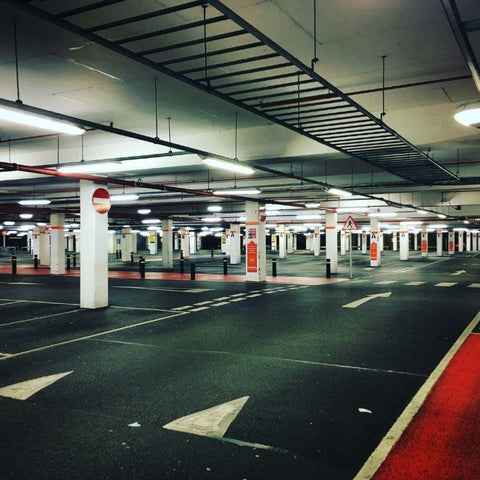
Underground car parks and industrial warehouses
Whether for car park lighting or warehouse lighting, LED battens provide safety, robustness and efficiency, even in the most demanding conditions.
| Space | Use | Recommendation | Selection criteria | Examples |
|---|---|---|---|---|
| Underground car parks | Driveways | 150 cm IP65 battens every 5 to 7 m, cool white (≈ 6000 K) |
|  |
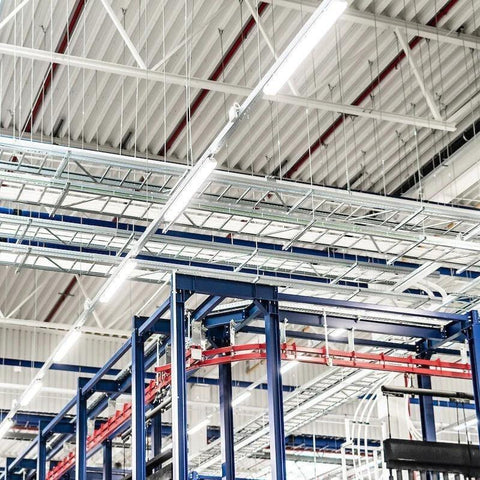
| Industrial warehouses | High ceilings (>4 to 5 m) | Powerful suspended LED battens |
|  |
| Industrial warehouses | Standard height | 150 cm battens ~50 W (≈ 6,000 lm) in parallel rows |
|  |
Checklist for choosing the right LED batten
- Installation location: dry indoor, damp (IP44+), outdoor (IP65+).
- Area to be lit: suitable length and power (lumens required).
- Use: desired atmosphere (warm/neutral/cool white), colour rendering (CRI).
- LED batten type: integrated, T8 tube, recessed, suspended, linkable, etc.
- Handy options: sensor, emergency battery, rechargeable.
- Quality and durability: efficacy (lm/W), lifespan, robustness (IK, IP).
If you can tick all the boxes, you have the LED batten best suited to your needs.