





Tube type: T8 or T5?
The first step is to identify the type of LED tube you need, usually T8 or T5, which refers to its diameter and its connection cap (base). These two standards are not interchangeable: a T8 tube will not fit in a fitting designed for T5, and vice versa. The table below summarises their characteristics:
| Type | Diameter | Cap (base) | Standard lengths |
|---|---|---|---|
| T8 | 26 mm (1 inch) | G13 (pins 13 mm apart) | 60, 90, 120, 150 cm |
| T5 | 16 mm (5/8 inch) | G5 (pins 5 mm apart) | 30, 60, 90, 120, 150 cm |
→ T8 LED tubes: this is the most widespread format. T8 LED tubes replace standard fluorescent tubes of the same length (very common in garages, car parks, workshops and so on). A T8 LED tube is 26-28 mm in diameter and uses a two-pin G13 cap (pins 13 mm apart). T8 LED tubes mainly come in 60, 120 or 150 cm (sometimes also 90 cm). Thanks to its high light output, this format is well suited to offices, shops and industrial premises.
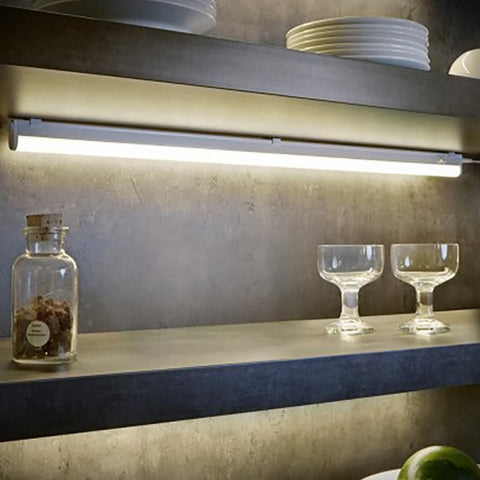
→ T5 LED tubes: slimmer (16 mm in diameter, G5 cap with pins 5 mm apart), T5 LED tubes are used in more compact fittings. Traditionally, T5 fluorescent tubes came in specific lengths (e.g. around 115 cm), but T5 LED tubes are now available in lengths close to T8 (60, 120, 150 cm, etc.) to make the switch easier. Their slim profile allows discreet installation in tight spaces or designer fittings (display cases, illuminated shelves, kitchen units) while still delivering intense light.
Important
Check the cap and diameter carefully before replacing a tube, so you choose the right type (G13 vs G5).

LED tube length: which size should you choose?
Choose the length of the LED tube according to your existing installation or the space to be lit. The standard lengths (approximately, pins included) and their typical uses are:
| LED tube length | Typical uses |
|---|---|
| 30 cm LED tube | Very small spaces: cupboards, cabinet displays, above mirrors. |
| 60 cm LED tube | Worktops, small offices or utility rooms, narrow corridors and passageways. |
| 90 cm LED tube | Home kitchens, bathrooms, small shops or small workshops. |
| 120 cm LED tube | The most common in professional settings: effectively lights offices, garages, workshops or medium-sized shops. |
| 150 cm LED tube | Long lengths for large spaces: warehouses, industrial workshops, car parks or large retail areas. |
Practical tip
Measure the old tube precisely (pins included) before buying the new one, to ensure a perfect fit. In a renovation, ideally choose the same length as the fluorescent tube being replaced, so you can reuse the existing fitting without modification. In a new installation, select the length according to the area to be lit: the larger the space or the higher the ceiling, the longer and more powerful the LED tube needs to be (or install several in parallel for even coverage).

LED tube power and brightness: watts vs lumens
Understanding the difference
- Watts (W) = power consumption.
- Lumens (lm) = actual amount of light emitted.
Good to know
Two tubes with the same wattage can produce very different brightness depending on their efficiency.
Luminous efficacy
- Recent LED tubes: 100 to 150 lm/W.
- Conventional fluorescent tubes: ≈ 50 lm/W.
Example:
- A 120 cm fluorescent tube, 36 W ≈ 1,800 lm.
- A 120 cm LED tube, 18 W ≈ 1,800 to 2,700 lm.
For the same brightness, LED uses half as much energy.
Matching lumens to the application
Required illuminance levels and light intensity:
| Type of space | Recommended illuminance (lux) | Example of total requirement |
|---|---|---|
| Office / shop | 300-500 lx | 20 m² × 300 lx = 6,000 lm |
| Industrial workshop | 300-800 lx | Depending on area and tasks |
| Warehouse / car park | 100-200 lx | Large area, high output |
Equivalent wattages
| Fluorescent tube | Equivalent LED tube | Expected luminous flux |
|---|---|---|
| 36 W | ≈ 18 W | ≈ 1,800-2,000 lm |
| 58 W | ≈ 24 W | ≈ 2,400-3,000 lm |
Always compare lumens, not just watts.
Colour temperature: choosing the right shade
The colour temperature of an LED tube, expressed in kelvins (K), shapes the atmosphere of the lighting. There are three main shades of white:
- Warm white (~2700-3000 K): a yellowish-orange shade reminiscent of old incandescent bulbs. It creates a warm, relaxing atmosphere. Use: ideal for reception areas, restaurants, hotels or any space where you want a cosy, welcoming feel.
- Neutral white (~4000 K): neutral white light, close to midday daylight. It offers excellent visual comfort with no colour cast. Use: recommended for indoor workspaces such as offices, classrooms, kitchens and workshops, where good concentration is needed without tiring the eyes.
- Cool white (~5000-6500 K): white light with a slight bluish tint, very bright and stimulating. Use: suitable for areas requiring high visibility and strong illuminance: warehouses, factories, garages, car parks or laboratories. This white enhances contrast and detail, helping with precision tasks.
In practice, the choice depends on the effect you want. For a warm look (hotel, upmarket shop), warm white is preferred, whereas for a working or industrial environment, neutral to cool white maximises visibility. Note that colour temperature affects both the overall atmosphere and long-term visual comfort.


LED tube power supply: single-ended or double-ended?
LED tubes can be designed to be powered from one end (single-ended) or from both ends (double-ended). This matters mainly in renovation work, if you want to reuse your old batten fittings:
- Single-ended LED tube: live and neutral both arrive at the two pins at one end of the tube, while the other end is only a mechanical support. This is the newest and most common system on today's LED tubes, especially for new LED batten fittings. This one-sided wiring is safer when replacing tubes (only one end is live) and simplifies installation when you start afresh with suitable equipment.
- Double-ended LED tube: live is fed in at one end and neutral at the other, just like original fluorescent tubes. This type of LED tube is often described as a retrofit tube, as it is designed to be installed in an old fitting without changing the existing two-sided wiring. Strictly speaking, there is no starter on an LED tube, but the connection follows the conventional configuration.
Which should you choose?
- New installation or replaced fitting → choose a single-ended LED tube (the current standard).
- Replacement in an existing fitting → check the wiring diagram (single or double-ended) and the tube's compatibility.
- Watch out for the ballast: you may need to bypass it and remove the starter.
- If in doubt, call an electrician to adapt the wiring safely.

Other criteria for choosing an LED tube
In addition to the main points above, here are some other criteria not to overlook for the best choice:
- Ingress protection (IP) rating: the IP rating indicates the tube's resistance to dust and water. For a dry indoor space (offices, shops), an IP20 LED tube is more than enough. For a garage, car park or area exposed to damp or dust, however, choose an IP65 LED tube (dust-tight and protected against water jets). IP65 LED tubes with seals and waterproof end caps are ideal in industrial or outdoor environments.
- Colour rendering index (CRI): for quality lighting, make sure the LED tube has a CRI of at least 80. A CRI ≥ 80 guarantees good colour rendering, which is sufficient in most cases. In demanding retail settings (bakeries, art galleries, clothing), you can opt for CRI 90+ to show products off with true-to-life colours.
- Beam angle: unlike old fluorescent tubes, which emitted light at 360°, LED tubes are more directional (the LEDs are arranged on one side of the tube). The standard beam angle is around 120°: it lights forwards, which suits most uses. Some LED tubes offer a wider angle (240-270°) thanks to a specially designed diffuser, providing more even light similar to a traditional fluorescent tube (useful for large spaces or fittings without a reflector).
- Electrical compatibility: make sure the tube you choose is suited to your electrical installation. Besides the ballast issue already mentioned, note that LED tubes generally support a 220-240 V AC voltage range (mains power). Standard models do not need an external transformer (they have a built-in driver). However, do not attempt to install an LED tube in a ballast fitting without following the instructions: the tube type (compatible with an electronic ballast or not) must be correct, otherwise it may malfunction.
- Certifications and standards: for use in businesses or public buildings, LED tubes must meet safety and environmental standards. Check for the CE marking (European conformity) and RoHS certification (no hazardous substances). These labels guarantee a safe product that complies with regulations. All Silumen LED tubes meet both certifications.
Choosing an LED tube for your application
Your final decision should take into account where the LED tube will be used. The criteria above carry different weight depending on whether you are lighting a living room or a huge warehouse. Here are some recommendations by type of application, with a focus on professional, retail and industrial settings:
| Application | Recommended length | Colour temperature | Recommended CRI | Key points | Examples |
|---|---|---|---|---|---|
| Residential lighting (home, garage) | 60 cm, 90 cm or 120 cm |
| ≥ 80 |
|  |
| Professional lighting (offices, schools, commercial buildings) | 120 cm T8 | Neutral (~4000 K) | ≥ 80 (≥ 90 for colour-critical tasks) |
|  |
| Retail lighting (shops, hotels, restaurants) | 120 cm or 150 cm |
| High CRI (≥ 90 depending on sector) |
|  |
| Industrial lighting (workshops, warehouses, car parks) | 150 cm high-output T8 | Cool (~6000 K) | ≥ 80 |
|  |
In conclusion, choosing an LED tube means looking at both the technical characteristics of the tube (format, power, colour temperature, etc.) and the requirements of your specific application. By following these criteria, you will ensure efficient, long-lasting and safe lighting that perfectly matches your needs. Every project is unique, but a good LED tube stands out for its efficiency, reliability and suitability for your environment. With this guide, you have all the key points to make the right choice. Happy installing!